
Gold nanoparticle physical properties depend strongly on particle size, shape, surface chemistry, and surrounding environment. At the nanoscale, a large fraction of the material is associated with or influenced by the particle surface, making interfacial properties especially important for colloidal stability, functionalization, transport, and interactions with other materials.
Understanding these relationships helps with selecting a particle size and surface for a particular application. Optical behavior is also strongly size- and shape-dependent and is discussed separately in Gold Nanoparticle Optical Properties.
Choosing a gold nanoparticle size or surface?
Explore gold nanospheres, nanoshells, and nanorods across a range of particle sizes and surface chemistries.
Particle Size, Surface Area & Volume
As particle diameter decreases, surface area becomes increasingly large relative to particle volume. For a sphere, the surface area-to-volume ratio is:
Surface area / volume = 6 / diameter
This relationship means smaller nanoparticles have proportionally more surface available to interact with ligands, biomolecules, solvents, and surrounding materials. Particle size can therefore influence surface functionalization, colloidal behavior, diffusion, and other application-relevant properties.
| Diameter (nm) |
Surface Area (nm2) |
Volume (nm3) |
Surface Area / Volume (nm-1) |
|---|---|---|---|
| 10 | 314 | 523 | 0.60 |
| 20 | 1,260 | 4,190 | 0.30 |
| 40 | 5,030 | 33,500 | 0.15 |
| 80 | 20,100 | 268,000 | 0.075 |
| 100 | 31,400 | 523,600 | 0.060 |
Particle size also affects gold nanoparticle optical properties. Changes in diameter alter the relative contributions of absorption and scattering and can shift or broaden the localized surface plasmon resonance. See Gold Nanoparticle Optical Properties for a more detailed discussion.
Shape & Crystallinity
Gold nanoparticles can be synthesized in a variety of morphologies, including spheres, rods, shells, and other anisotropic structures. Particle shape emerges from the way gold atoms nucleate and grow during synthesis.
Anisotropic structures can be produced by controlling the relative growth rates of different crystal facets. Seed structure, facet-selective ligands or surfactants, reagent concentrations, and reaction conditions can all influence the resulting morphology.
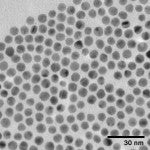
Small gold nanospheres
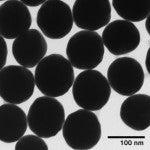
Large gold nanospheres
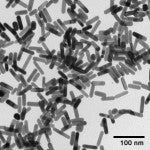
Gold nanorods
Morphology can have a major effect on particle properties. Spherical nanoparticles exhibit a different plasmonic response than anisotropic particles such as gold nanorods or core-shell structures such as gold nanoshells.
Gold Nanoparticle Surface Chemistry
The surface of a gold nanoparticle determines how the particle interacts with its surrounding environment. Surface-bound molecules, often called ligands or capping agents, can influence surface charge, colloidal stability, solvent compatibility, biomolecule interactions, and subsequent functionalization.
Gold nanoparticle surfaces can be stabilized through electrostatic repulsion, steric hindrance, or a combination of both mechanisms.
| Mechanism | How It Stabilizes the Particle |
|---|---|
| Electrostatic | Like-charged particle surfaces repel one another through interactions associated with the electrical double layer. Stability can change substantially with pH and ionic strength. |
| Steric | Surface-bound polymers or other ligands create a physical barrier that limits close particle-particle contact and aggregation. |
| Combined | Some coatings provide both surface charge and steric protection, allowing multiple stabilization mechanisms to contribute simultaneously. |
Citrate is a common example of a relatively labile, negatively charged capping agent used with aqueous gold nanoparticles. It provides electrostatic stabilization while leaving the surface accessible for subsequent modification. Polymer coatings such as PVP can provide stronger steric stabilization but may be more difficult to displace during ligand exchange.
Surface requirements depend on the intended application. Rather than assuming one chemistry is optimal for every system, consider the downstream buffer or solvent, ionic strength, functionalization strategy, and molecules that will contact the particle. Current surface options vary across the gold nanoparticle portfolio.
Functionalizing the Gold Surface
Gold nanoparticles can be modified with polymers, proteins, peptides, oligonucleotides, and other molecules to introduce new surface properties or biological functionality. Modification can occur through passive adsorption, ligand exchange, affinity interactions, covalent conjugation to functionalized coatings, or strong interactions between gold and sulfur-containing ligands.
Surface engineering can also introduce reactive groups such as carboxyl groups or add inorganic shells that alter particle compatibility or optical behavior. When a standard surface does not meet the requirements of an application, custom nanoparticle development can be used to evaluate alternative coatings, functional groups, or formulations.
Gold Nanoparticle Colloidal Stability
Colloidal stability describes the ability of nanoparticles to remain dispersed rather than forming aggregates. Stability depends on the particle surface as well as the surrounding solution, so a particle that is stable in one formulation may behave differently after transfer into another buffer or solvent.
Important variables include particle size, surface chemistry, pH, ionic strength, solvent composition, concentration, temperature, and the presence of proteins or other molecules that can adsorb to the particle surface.
Salt is particularly important for electrostatically stabilized nanoparticles because increasing ionic strength can screen surface charge and reduce repulsive interactions between particles. Sterically stabilized particles may respond differently because physical separation provided by the surface coating also contributes to stability.
Using Zeta Potential to Evaluate Surface Charge
Zeta potential provides information about electrostatic behavior at the particle-solution interface, but it should not be interpreted using a single universal stability threshold. The measured value depends strongly on solution conditions, including pH, ionic strength, solvent properties, and the composition of the particle surface.
Sterically stabilized nanoparticles may also remain colloidally stable even when the magnitude of their zeta potential is relatively low. For meaningful comparisons, report and control the solution conditions used for the measurement.
Monitoring Aggregation
Several complementary analytical techniques can be used to monitor changes in gold nanoparticle dispersion state:
- UV-Visible spectroscopy: Aggregation can broaden, shift, or introduce longer-wavelength features into the plasmon extinction spectrum.
- Dynamic light scattering (DLS): An increase in hydrodynamic size can indicate the formation of particle aggregates.
- Electron microscopy: TEM provides direct information about particle dimensions and morphology, although sample preparation means it does not directly measure dispersion behavior in the original liquid state.
Learn more about these methods in Nanoparticle Characterization Techniques and about the optical signatures of aggregation in Gold Nanoparticle Optical Properties.
Measuring Gold Nanoparticle Concentration
Gold nanoparticle concentration can be expressed in several ways, including gold mass concentration, particle number concentration, atomic gold molarity, mass percent, or optical density. The most useful unit depends on the application.
Particle number concentration is strongly dependent on nanoparticle diameter. At the same total gold mass concentration, a dispersion of smaller nanoparticles contains many more individual particles than a dispersion of larger nanoparticles. Optical density also changes with particle size because the extinction cross section of each particle changes.
For conversions between particle size, particle number concentration, gold mass concentration, and optical response, see the Gold Nanoparticle Concentration & Optical Reference Data.
Choosing Gold Nanoparticle Physical Properties
The appropriate combination of size, shape, surface chemistry, and formulation depends on what the nanoparticle must do in the final system. Particle dimensions determine surface area and strongly influence optical behavior, while surface chemistry controls interactions with solvents, biomolecules, polymers, and neighboring particles.
For applications where especially narrow particle size distributions are important, explore Ultra Uniform Gold Nanospheres. For projects requiring a different particle size, morphology, surface, or formulation than the standard portfolio, see Custom Nanoparticle Development.
Related gold nanoparticle resources