
Gold colloid, also called colloidal gold, is a dispersion of gold nanoparticles in a liquid, most commonly water. The properties of the dispersion depend not only on the gold nanoparticle itself, but also on particle size distribution, aggregation state, concentration, surface chemistry, solvent environment, and purity.
These formulation variables can influence optical response, colloidal stability, biomolecule interactions, and compatibility with downstream processes. Selecting the right gold colloid therefore requires considering both the nanoparticle and the environment in which it will be used.
Need colloidal gold in a specific size or surface chemistry?
Explore gold nanospheres across a range of particle sizes, surface chemistries, concentrations, and formulation options.
What Makes a Good Gold Colloid?
The most important gold colloid characteristics depend on the application, but several properties should be considered when comparing materials or selecting a formulation.
| Property | Why It Matters |
|---|---|
| Particle Size Distribution | A narrow size distribution improves consistency in size-dependent optical, transport, and surface properties. |
| Aggregation State | Particle aggregation changes effective size, optical behavior, available surface area, and downstream performance. |
| Concentration | The required concentration depends on the application and can affect processing, dosing, optical density, and formulation flexibility. |
| Surface Chemistry | The capping agent controls colloidal stability, surface charge, biomolecule interactions, and compatibility with further functionalization. |
| Solvent Compatibility | The particle surface must maintain dispersion stability in the aqueous buffer, organic solvent, polymer system, or other environment used downstream. |
| Purity | Residual synthesis reagents, free ligands, salts, or other impurities can interfere with subsequent reactions and applications. |
| Colloidal Stability | Stability against changes in pH, ionic strength, temperature, concentration, and storage conditions helps maintain consistent particle properties. |
How Gold Colloids Are Produced
Gold nanoparticles are commonly synthesized in solution by reducing gold ions in the presence of reagents that control nucleation, particle growth, and surface stabilization. Early nucleation produces small gold seeds, which then grow as additional gold is reduced onto the developing particles.
Reaction conditions such as reagent concentration, mixing, temperature, and growth kinetics can be adjusted to control the final particle size and size distribution. The classic Turkevich and Frens methods established many of the principles still used in solution-phase gold nanoparticle synthesis today.1,2
Modern synthesis and processing methods can extend these principles across a broad range of particle sizes, morphologies, surfaces, and formulations. For requirements outside the standard catalog, nanoComposix also supports custom nanoparticle development.
Gold Colloid Size Distribution
Gold nanoparticle properties are strongly size-dependent, making particle-size distribution an important consideration when selecting a colloid. A broad distribution can introduce variation in optical response, diffusion behavior, surface area, and other particle characteristics.
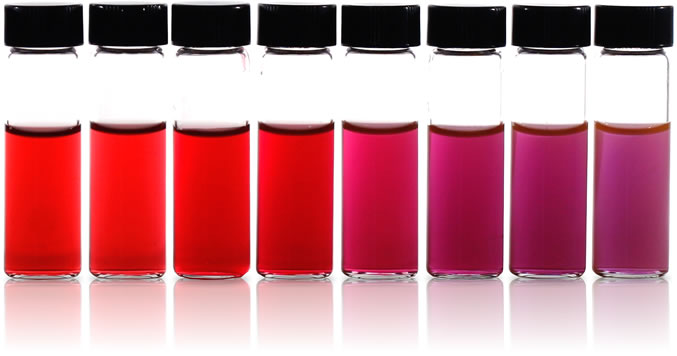
Particle uniformity should be evaluated using size-specific specifications rather than assuming the same coefficient of variation applies across every particle diameter or product platform. For applications requiring particularly tight particle-size distributions, see Ultra Uniform Gold Nanospheres.
Learn more about the relationship between size, morphology, surface chemistry, and other material characteristics in Gold Nanoparticle Physical Properties.
Aggregation State: Colloid vs. Dried Powder
Maintaining discrete nanoparticles is important because aggregation changes the effective size and properties of the material. In optical applications, aggregation can alter the plasmon resonance and produce substantial changes in absorption and scattering. In biological and surface-functionalization workflows, aggregation can also reduce accessible surface area and change transport behavior.
Colloidal formulations allow nanoparticles to remain dispersed in a compatible liquid environment throughout storage and use. Drying nanoparticles without an appropriate surface chemistry or processing method can promote strong particle-particle interactions that make complete redispersion difficult.
When a dry format is needed, the formulation should be specifically designed for redispersion. Selected nanoComposix products, including PVP-stabilized gold nanospheres, are available in dried formats intended to provide greater flexibility in solvent selection and final concentration.
Gold Colloid Concentration & Purity
Gold colloid concentration may be reported as gold mass per volume, particle number concentration, or optical density depending on the material and application. These values are related but are not interchangeable without considering nanoparticle size and optical properties.
Higher-concentration dispersions can reduce the amount of solvent introduced into a downstream formulation and provide greater flexibility when preparing working concentrations. Lower-concentration materials may be convenient for direct optical characterization or experiments that require less material.
For reference conversions between gold mass concentration, particle concentration, and optical density across different nanoparticle sizes, see the Gold Nanoparticle Concentration & Optical Reference Data.
Purification is also important. Soluble synthesis reagents, salts, and unbound surface ligands may affect downstream chemistry or biological interactions. Washing, concentration, and buffer-exchange processes can be used to reduce these residual components while maintaining particle dispersion.
Surface Chemistry & Solvent Compatibility
The molecules associated with the gold nanoparticle surface are commonly referred to as capping agents or surface ligands. These molecules help stabilize the colloid and influence surface charge, steric interactions, solvent compatibility, and subsequent functionalization.
Some surface chemistries are relatively easy to displace, making them useful starting points for ligand exchange or biomolecule attachment. Others bind more strongly or provide greater steric stabilization and may be preferred when long-term colloidal stability or compatibility with challenging solution conditions is the priority. Gold surfaces can also be functionalized with peptides and other biomolecules to introduce additional functionality.3
Common nanoComposix gold nanoparticle surfaces include citrate, PEG-based coatings, PVP, BPEI, carboxyl-functionalized surfaces, and other platform-specific chemistries. Availability depends on particle size and format, so refer to the current gold nanoparticle portfolio for specific combinations.
Surface modification can also be used to transfer nanoparticles into different solvent environments or introduce functional groups for subsequent conjugation. For a more detailed discussion, see Gold Nanoparticle Physical Properties.
Gold Colloid Stability
Gold colloid stability depends on the balance of forces that keep individual nanoparticles separated. Particle size, surface chemistry, concentration, solvent, ionic strength, pH, and temperature can all influence this balance.
For example, increasing salt concentration can reduce electrostatic stabilization in some aqueous gold colloids, while polymer coatings may provide additional steric stabilization. A surface chemistry that performs well in one formulation may therefore behave differently after transfer into another buffer or solvent.
When changing solution conditions, evaluate the colloid after the change rather than assuming stability will be preserved. For gold nanoparticles, UV-Vis optical properties can provide a sensitive indication of aggregation because particle-particle interactions alter the plasmonic response.
Batch Consistency & Characterization
Colloidal nanoparticle synthesis is sensitive to reaction conditions, so consistent control of particle size, size distribution, surface chemistry, and formulation is important for reproducible downstream performance.
nanoComposix gold nanoparticles are supplied with batch-specific Certificates of Analysis containing characterization relevant to the individual product. Depending on the platform, measurements may include transmission electron microscopy (TEM), dynamic light scattering (DLS), zeta potential, UV-Visible spectroscopy, and solution pH.
These techniques provide complementary information. TEM measures the physical dimensions of the nanoparticle core, while DLS evaluates hydrodynamic behavior in solution. UV-Vis spectroscopy provides information about optical response and can reveal changes associated with aggregation.
See Nanoparticle Characterization Techniques for more information about choosing and interpreting nanoparticle measurements.
Where Are Gold Colloids Used?
Gold colloids are used across a broad range of research and product-development applications. The formulation requirements can differ substantially between these uses.
| Application | Key Considerations |
|---|---|
| Diagnostics | Reporter signal, conjugation chemistry, particle uniformity, stability, and reproducible performance at scale. Antibody-gold conjugates have a long history of use in immunoassay and rapid diagnostic formats.4 |
| Optical Engineering | Precise control of particle size, morphology, refractive environment, absorption, and scattering. |
| Biomedical & Nanomedicine Research | Surface functionality, purity, formulation, biological compatibility, and control of particle interactions. Plasmonic gold nanoparticles have also been widely studied for photothermal applications.5 |
| Electron Microscopy | High electron density, controlled particle size, and surface functionalization for labeling and contrast. |
For a broader introduction to these applications and the different gold nanoparticle formats available, see Introduction to Gold Nanoparticles.
Selecting the Right Gold Colloid
Start by defining the particle and formulation requirements imposed by the application:
- Particle size and uniformity: What physical or optical properties need to be controlled?
- Surface chemistry: Does the material need to remain stable as supplied, undergo ligand exchange, or support biomolecule conjugation?
- Solvent and buffer environment: What pH, ionic strength, solvent, or formulation components will the particles encounter?
- Concentration: Is the supplied concentration suitable for direct use, dilution, or further processing?
- Purity: Are residual reagents or formulation components important to the downstream application?
- Characterization: Which particle attributes need to be measured or controlled for reproducible performance?
When an off-the-shelf formulation does not meet these requirements, custom nanoparticle development can be used to evaluate alternative particle sizes, surface chemistries, optical properties, solvents, or formulation conditions.
Related gold nanoparticle resources
- Introduction to Gold Nanoparticles
- Gold Nanoparticle Physical Properties
- Gold Nanoparticle Optical Properties
- Ultra Uniform Gold Nanospheres
- Gold Nanoparticle FAQs
References
- Frens, G. “Controlled nucleation for the regulation of the particle size in monodisperse gold suspensions.” Nature Physical Science 1973, 241, 20–22.
- Turkevich, J.; Stevenson, P. C.; Hillier, J. “A study of the nucleation and growth processes in the synthesis of colloidal gold.” Discussions of the Faraday Society 1951, 11, 55–75.
- Wang, Z.; Levy, R.; Fernig, D. G.; Brust, M. “The Peptide Route to Multifunctional Gold Nanoparticles.” Bioconjugate Chemistry 2005, 16, 497–500.
- Johne, B.; Hansen, K.; Mork, E.; Holtlund, J. “Colloidal gold conjugated monoclonal antibodies, studied in the BIAcore biosensor and in the Nycocard immunoassay format.” Journal of Immunological Methods 1995, 167–174.
- Huang, X.; Jain, P. K.; El-Sayed, I. H.; El-Sayed, M. A. “Plasmonic photothermal therapy (PPTT) using gold nanoparticles.” Lasers in Medical Science 2008, 23, 217–228.