

Nanomaterials for Optical Engineering
Design and control optical response with precision nanomaterials from nanoComposix. Tune plasmonic resonance, control scattering, enhance signal generation, and spur innovation of next-generation optical systems.
Schedule a ConsultationImprove Optical System Performance with Nanomaterials
- Tunable absorption and scattering through controlled plasmonic resonance and dielectric properties
- Enhanced electromagnetic field localization for sensing and spectroscopy
- High refractive index and large optical cross sections for compact and efficient display systems
- Consistent optical response enabled by tight size and shape distributions
- Stable integration into coatings, matrices, and optical assemblies


Optical Nanomaterials Overview
Sensitive optical engineering applications begin with selecting the appropriate nanomaterial platform, followed by tuning particle size, shape, and surface chemistry to achieve the desired optical response.
The application areas below highlight design criteria and uses of different classes of nanomaterials in optical and plasmonic engineering. Nanoparticle size, morphology, and surface chemistry can be tuned within each class to impart specific optical effects and meet integration requirements.
| Highlighted application | Engineering requirement |
|---|---|
| Spectral filtering | Precise spectral tuning of absorption and scattering across the visible and near-infrared via control of material, size, and morphology. ★ Nanoparticle Solutions: Gold nanospheres; gold nanorods; gold nanoshells; silver nanospheres; aluminum nanoparticles |
| Refractive index tuning and controlled optical scattering | Stable, non-absorbing particles with tightly controlled size to control refractive index and scatter from thin films and composites. ★ Nanoparticle Solutions: Silica nanospheres (SiO2); titania nanoparticles (TiO2) |
| UV plasmonics | Materials with plasmonic response in the ultraviolet and low optical losses. ★ Nanoparticle Solutions: Aluminum nanoparticles |
| Layer spacing and optical gap control | Nanometer-scale uniformity to control coupling, interference, and layer separation in devices. ★ Nanoparticle Solutions: Silica nanospheres; silica-coated plasmonic nanoparticles |
| Instrument calibration and plasmonic reference materials | Highly uniform particles with extremely tight size and shape distributions and well-defined optical responses. ★ Nanoparticle Solutions: Gold nanospheres; silver nanospheres; silica nanospheres |
| Surface-enhanced spectroscopy (e.g., SERS) | Reproducible electromagnetic hotspots and strong near-field enhancement driven by sharp features and controlled interparticle spacing to enhance Raman and fluorescent signals. ★ Nanoparticle Solutions: Silver nanoparticles; silver nanocubes; gold nanorods; silica-coated plasmonic nanoparticles |
| Next-generation biosensors | Enhance the performance of on-chip and microfluidic devices by tailoring optical response, light coupling, and analyte interactions. ★ Nanoparticle Solutions: Gold nanospheres; gold nanorods; gold nanoshells; magnetic gold nanoshells; silver nanospheres; silver nanocubes |
| Visit our Nanoparticles for Diagnostics webpage to learn more | |
Table 1: Description of optical engineering applications enabled by precisely engineered nanomaterials
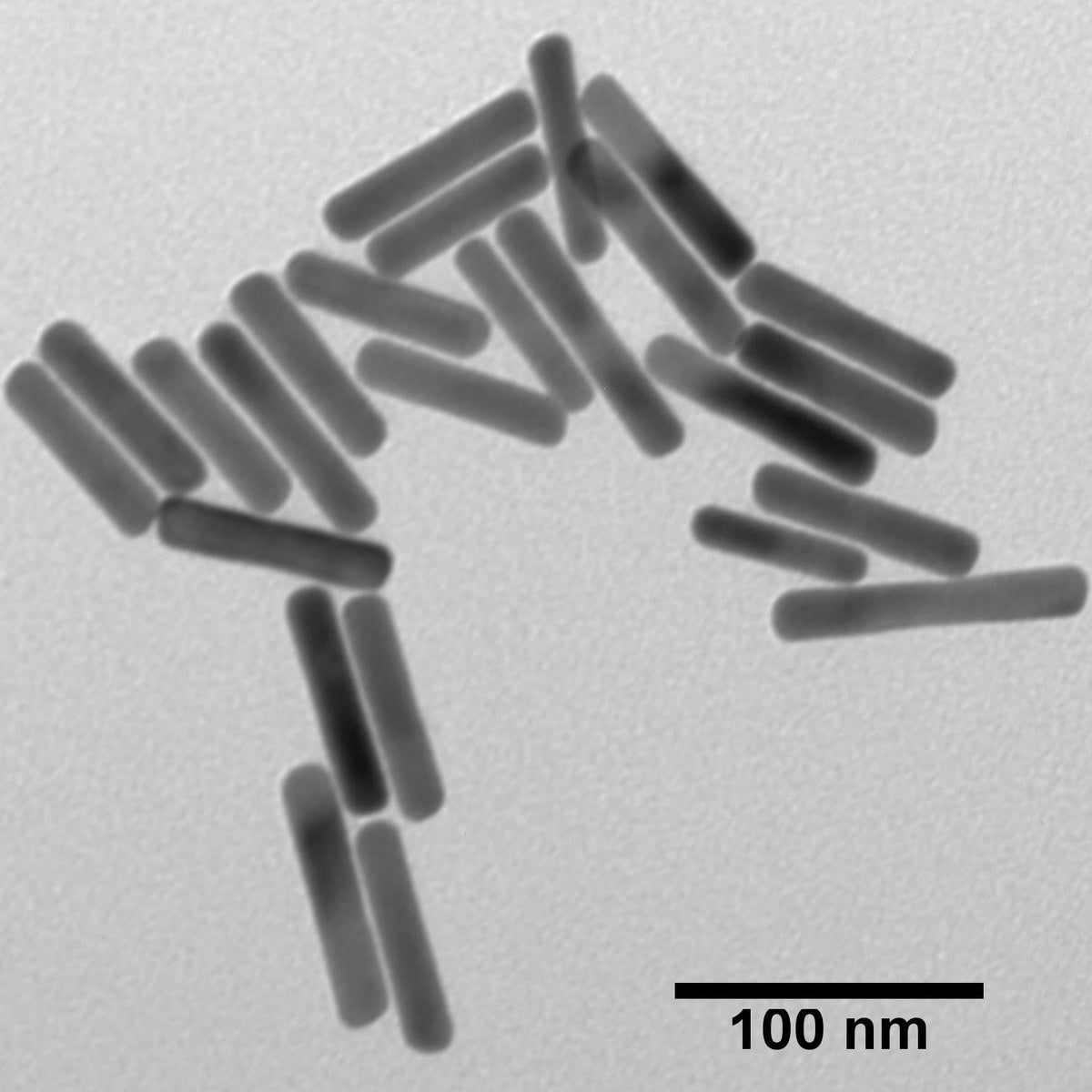
Nanoparticle size and morphology directly influence extinction spectra, scattering efficiency, and field enhancement. Narrow size distributions improve batch-to-batch reproducibility and spectral consistency, while anisotropic shapes such as rods, shells, and cubes enable wavelength tuning and localized field enhancement critical for many optical engineering applications.
From optical signatures to engineered performance
Aluminum
Plasmonic activity in the UV enables integration into metamaterials for reflective coatings. |
Silver Nanocubes
Anisotropic morphology and sharp corners enable high sensitivity sensing such as SERS. |
Silica
Precise shape control enables high-quality optical films for anti-glare or index-tuning layers. |
Quality You Can Rely On
- Batch-specific characterization and in-depth nanoparticle analysis
- Reproducible and scalable processes for commercial viability
- cGMP capabilities
- Made in USA
Connect with our Nanomaterial Experts
Nanomaterial Surface Chemistries
Surface chemistry plays a critical role in determining dispersion stability, optical peak position, and compatibility with optical system environments. nanoComposix experts work with you to select surface options to preserve critical optical properties and support downstream integration.
| Surface Chemistry | Description |
|---|---|
 |
Citrate provides stabilization in aqueous systems while allowing strong coupling of nanoparticles with their surroundings. A highly modular surface chemistry to allow downstream modification for use in optical characterization, spectroscopy, and early-stage prototyping. |
 |
Silica coatings improve chemical, thermal, and mechanical robustness while maintaining the optical response of the core nanoparticle. Suitable for integration into coatings, composites, and optical materials. Silane modification of particles or silica coatings adds additional chemical flexibility for modification, assembly, and spacing. |
 |
Polymers such as poly(ethylene glycol) (PEG) reduce non-specific interactions and aggregation in biological systems, supporting long-term colloidal stability in optically sensitive systems. Others, such as Polyvinylpyrrolidone (PVP) provide good stability in more volatile solvents for spin coating. |
 |
Carboxyl groups enable robust covalent bioconjugation via established coupling chemistries (e.g., EDC/NHS), allowing attachment of antibodies, enzymes, peptides, and nucleic acids. This supports controlled biofunctionalization for targeted recognition and signal transduction in optical and electrochemical biosensing platforms. |
 |
The surface functionality of materials can be further customized to provide compatibility in specific solvent systems or to introduce reactive functional groups for conjugation or composite formation. |
Partner with nanoComposix for high quality nanomaterials
Nanoparticle expertise backed by:
- 20+ years developing innovative solutions for complex challenges
- ISO 13485 certification & GMP manufacturing capabilities
- Over 4,000 scientific citations and references
FAQ: Optical Nanomaterials
Can nanoComposix help me select the right nanoparticle for my application?
Yes. nanoComposix provides technical guidance for many nanoparticle-enabled applications and routinely help customers map performance requirements to particle composition, size, and shape. Connect with our team to discuss your application.
How do you ensure batch-to-batch reproducibility?
We rigorously control the synthesis of each batch and provide extensive characterization to support consistent performance in your application. Characterization methods are particle-specific, but we provide batch-specific Certificates of Analysis including:
- Size and stability – TEM, DLS
- Surface charge – Zeta potential
- Concentration – ICP-MS, mass balance
- Optical properties – UV-Vis
What resources do you have to support application integration?
Our optoelectronic nanomaterial experts guide selection of nanomaterial platform, size, morphology, and surface chemistry – connect with our team to start the conversation. Our Knowledge Base also contains support such as spin coating protocols for select materials.
What customization options do you offer?
We frequently collaborate with customers on application-focused challenges – our extensive catalog can be modified to fine tune optical properties, surface chemistry, concentration, and solvent, along with developing fully custom solutions outside our catalog. Our experience allows us to act as your technical partner, not just a materials supplier. Connect with our team to discuss your particle requirements.
Do you offer refractive index tuning for optical applications?
Yes. We support refractive index tuning by tailoring material, size, and surface chemistry to achieve targeted optical performance. Whether you need to increase scattering, improve light transmission, or fine-tune optical performance within a multilayer stack, we work with you to optimize materials for your design and process. Connect with our team to discuss your application.
Can nanomaterials be uniformly integrated into thin films or multilayer optical stacks?
Yes. Our nanomaterials are produced as high-purity colloidal dispersions that integrate smoothly into thin films and multilayer optical stacks using standard coating processes. Their stable, monodisperse nature prevents aggregation, ensuring uniform layers with predictable optical performance.