
Dodecanethiol is a hydrophobic surface ligand used to make metal nanoparticles compatible with organic solvents, low-surface-energy coatings, and nonpolar materials. Its thiol group binds strongly to gold and silver surfaces, leaving the hydrophobic alkyl chain exposed to the surrounding medium.
The resulting ligand layer provides steric stabilization and can help limit irreversible particle-particle contact during drying, allowing appropriately formulated nanoparticles to be dried and redispersed in compatible organic solvents. These properties make dodecanethiol useful for custom nanoparticle systems that require organic-solvent compatibility, incorporation into nonpolar matrices, or controlled deposition from low-surface-energy solvents.

Need nanoparticles compatible with organic solvents or nonpolar materials?
Dodecanethiol-coated nanoparticles are not offered as a standard catalog surface. Our technical team can evaluate custom hydrophobic surfaces, particle sizes, materials, solvents, and formulations around your application.
Dodecanethiol Surface Properties
- Surface character: Hydrophobic
- Binding: Strongly bound through the thiol group and not readily displaced under typical handling conditions
- Stabilization: Steric stabilization provided by the exposed alkyl chains
- Solvent compatibility: Compatible with a range of nonpolar and moderately polar organic solvents
- Drying and redispersion: Can support drying and subsequent redispersion in compatible organic solvents without significant agglomeration
Representative source material: 1-Dodecanethiol (Sigma-Aldrich, 471364)
Molecular weight: 202.40 g/mol
Why Use a Dodecanethiol Surface?
The primary advantage of dodecanethiol is its ability to create a hydrophobic nanoparticle surface with strong affinity for organic media. The alkyl chains surrounding the particle promote compatibility with nonpolar solvents and materials while providing a steric barrier between neighboring nanoparticles.
This surface chemistry can be particularly useful for:
- Dispersing nanoparticles in organic solvents
- Incorporating nanoparticles into nonpolar polymers and composite materials
- Coating processes that require uniform particle deposition from low-surface-energy solvents
- Drying nanoparticles and subsequently redispersing them in compatible organic media
Dodecanethiol coatings have primarily been used with small, sub-10 nm gold and silver nanoparticles. For larger particles requiring organic compatibility, polymeric surface coatings such as polystyrene may be more appropriate depending on the material and application.
Applications
- Incorporation of nanoparticles into nonpolar solvents, polymers, and composite materials
- Coating and particle-deposition applications
- Biodiagnostic and nanomedicine research requiring hydrophobic nanoparticle formulations
- Photothermal research
- In vitro and in vivo toxicology research
For additional examples involving nanoparticle integration into optical materials, see Nanomaterials for Optical Engineering and Photothermal Applications of Nanoparticles.
Solvent Selection & Redispersion
To redisperse dried dodecanethiol-coated nanoparticles, add an appropriate compatible solvent and vortex for approximately 30 seconds. The table below represents solvents evaluated with these particles and is not intended to be a comprehensive list. Other nonpolar solvents may also be compatible.
After redispersion, samples should be stored at 4°C and protected from light. See Storage & Handling for additional guidance.
| Solvent | Refractive Index, n | Polarity Index | Dry Particle Redispersibility |
|---|---|---|---|
| Toluene | 1.50 | 2.4 | High |
| Chloroform | 1.45 | 4.1 | High |
| Dichloromethane | 1.42 | 3.1 | High |
| Hexane | 1.38 | 0.1 | High |
| THF | 1.41 | 4.0 | High |
| DMF | 1.43 | 6.4 | None |
| DMSO | 1.48 | 7.2 | None |
| Acetonitrile | 1.34 | 5.8 | None |
| Isopropanol | 1.38 | 3.9 | None |
| Ethanol | 1.36 | 5.2 | None |
| Methanol | 1.33 | 5.1 | None |
| Water | 1.34 | 10.2 | None |
Effect of Solvent on Nanoparticle Optical Properties
UV-Visible spectroscopy can help distinguish changes in nanoparticle optical response after solvent transfer. Aggregation or changes in particle structure can alter the width, position, and shape of the plasmon resonance, including the appearance of additional extinction at longer wavelengths.
In the experiment below, 4 nm dodecanethiol-coated silver nanoparticles originally dispersed in hexane were dried and redispersed in a range of organic solvents. The UV-Visible spectrum of each redispersed sample was then compared with the original hexane dispersion.
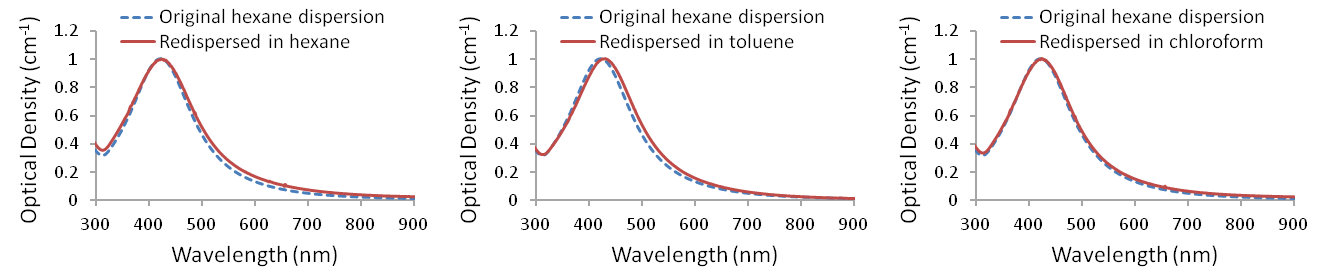

Small changes in the UV-Visible spectra are observed after redispersion compared with the original hexane sample. In this dataset, the spectral shifts and broadening are consistent with changes in the refractive index of the surrounding solvent rather than changes in particle size or significant agglomeration.
This distinction is important because the plasmon resonance of a metal nanoparticle responds to its local dielectric environment. A spectral shift after solvent transfer therefore does not necessarily indicate particle instability. Learn more in Silver Nanoparticle Optical Properties and The Science of Plasmonics.
Need a hydrophobic nanoparticle surface for your application?
Talk with our technical team about organic-solvent compatibility, polymer incorporation, particle size, drying and redispersion, or custom hydrophobic surface chemistry.
Related surface chemistry resources