
Lipoic acid is a strongly bound carboxyl surface chemistry used when a nanoparticle requires an accessible terminal carboxyl group for covalent conjugation. Lipoic acid contains a cyclic disulfide that can be reduced to two thiols, which bind strongly to noble-metal surfaces, while the carboxyl group remains exposed for further functionalization.
At appropriate pH, the terminal carboxyl group is negatively charged. It can also be activated using EDC/NHS chemistry to form an amide bond with molecules containing primary amines, including antibodies, proteins, and other biomolecules.

Looking for carboxyl nanoparticles for covalent conjugation?
Our 150 nm carboxyl gold nanoshells use a lipoic acid surface for EDC/NHS coupling. For gold nanospheres with a PEG spacer between the particle and terminal carboxyl group, see our PEG-carboxyl surface.
Lipoic Acid Surface Properties
- Surface charge: Negative above the carboxyl-group protonation region
- Isoelectric point: Approximately pH 4 in the 40 nm gold nanoparticle dataset shown below
- Binding: Strongly bound to the metal surface through sulfur groups and not readily displaced under typical handling conditions
- Functional group: Terminal carboxyl group available for further chemical modification
- Conjugation: Supports covalent coupling to primary amines using EDC/NHS chemistry
- Salt stability: More salt tolerant than weakly bound electrostatic stabilizers such as citrate, although stability depends on particle size and formulation
- Solvent compatibility: Water, ethanol, chloroform, and other compatible solvents depending on the nanoparticle formulation
Representative source material: Lipoic acid (Alfa Aesar, L04711)
Molecular weight: 206.3 g/mol
Why Use a Lipoic Acid Surface?
Lipoic acid combines a strongly anchored ligand with an accessible carboxyl functional group. This makes it useful when the nanoparticle coating needs to remain associated with the metal surface while providing a chemical handle for subsequent conjugation.
Compared with passive adsorption to a weakly bound surface such as citrate, carboxyl chemistry allows biomolecules containing primary amines to be attached through a covalent amide bond. This can provide a more robust conjugate when permanent attachment is important.
Lipoic acid and lipoic-dPEG12-COOH provide similar terminal carboxyl functionality but differ in the structure of the ligand layer. PEG-carboxyl includes a PEG spacer between the particle surface and terminal carboxyl group, which changes steric stabilization, hydrodynamic size, and salt tolerance.
Applications
- Covalent antibody and protein conjugation
- Lateral flow assay development
- Attachment of amine-containing biomolecules through EDC/NHS chemistry
- Further functionalization through terminal carboxyl chemistry
For practical conjugation guidance, see our Covalent Conjugation of Antibodies to Gold Nanoparticles resource and Nanoparticle Conjugation Protocols.
Lipoic Acid Surface Charge & Isoelectric Point

The figure above shows a representative zeta potential versus pH curve for lipoic acid-capped 40 nm gold nanoparticles. These data were generated by manual titration with HCl and NaOH followed by zeta potential measurement.
Lipoic acid-capped nanoparticles have a relatively low isoelectric point, approximately pH 4 in this dataset. They therefore remain negatively charged across most neutral and basic conditions as the terminal carboxyl groups become deprotonated.
The magnitude of the negative zeta potential increases as pH becomes more basic until approximately pH 9. At higher pH, the measured magnitude begins to decrease, likely because the increasing ionic content introduced during titration compresses the electrical double layer.
nanoComposix has observed similar overall pH-dependent zeta-potential behavior between comparable gold and silver nanoparticles for other charged surfaces, including citrate and BPEI. These observations can provide qualitative context when comparing metal nanoparticle systems, although the lipoic acid dataset shown here was measured specifically using 40 nm gold nanoparticles.
Learn more about how pH, ionic strength, and surface chemistry influence these measurements in Zeta Potential Measurements.
Salt Stability of Lipoic Acid-Capped Nanoparticles
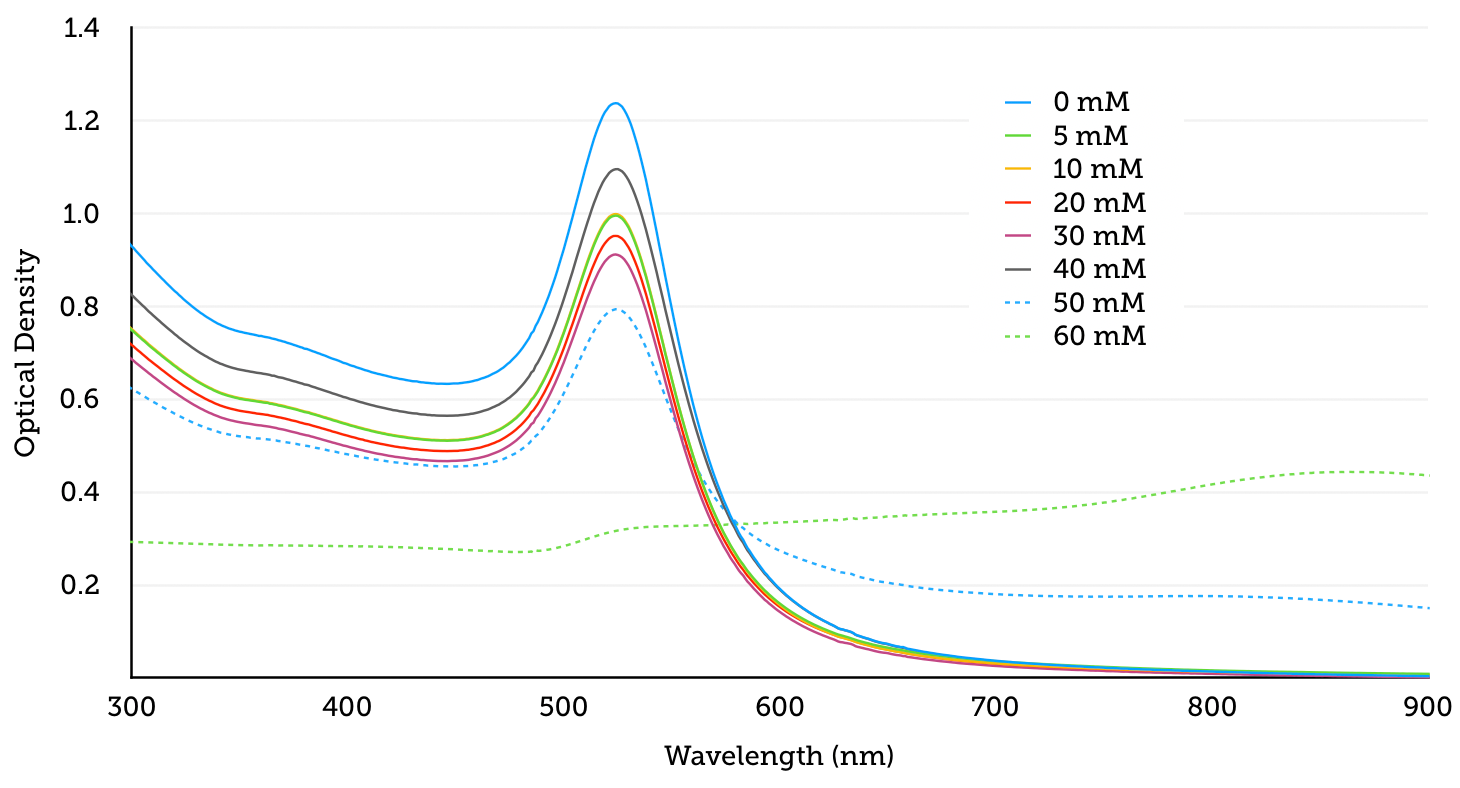
Increasing ionic strength can screen nanoparticle surface charge and compress the electrical double layer, reducing electrostatic repulsion between particles. The salt concentration at which this produces colloidal destabilization depends on particle size, material, ligand coverage, concentration, and solution conditions.
The figure above shows UV-Visible spectra of lipoic acid-capped 40 nm gold nanoparticles exposed to increasing concentrations of sodium chloride (NaCl). Separate nanoparticle dispersions were spiked with the indicated NaCl concentrations and incubated for 10 minutes before UV-Vis measurement.
Stable 40 nm gold nanoparticles retain their characteristic plasmon resonance near 520 nm. When aggregation occurs, the primary plasmon peak decreases and extinction increases at longer wavelengths, approximately 700–1100 nm, due to plasmon coupling between neighboring particles.
In this dataset, significant destabilization becomes apparent at approximately 50 mM NaCl. The 520 nm peak decreases and a broad longer-wavelength feature develops, consistent with nanoparticle aggregation.
This value is specific to the 40 nm gold nanoparticle formulation tested. Other lipoic acid-coated particles, including larger structures such as gold nanoshells, can exhibit different salt-stability behavior.
nanoComposix has generally observed lower salt stability for silver nanoparticles than for comparable gold nanoparticles with the same surface chemistry.
See Salt Stability of Nanoparticles for comparisons among different nanoparticle surface chemistries.
Is lipoic acid the right carboxyl surface for your conjugate?
Talk with our technical team about covalent conjugation, EDC/NHS coupling, particle size, salt stability, or choosing between lipoic acid and PEG-carboxyl surface chemistries.
Related surface chemistry resources