
Magnetic iron oxide nanoparticles combine nanoscale dimensions with magnetic responsiveness, making them useful for magnetic separation, biosensing, ferrofluids, nanotoxicology research, imaging research, and other magnetic nanotechnology applications. nanoComposix iron oxide nanoparticles are largely composed of magnetite (Fe3O4) and exhibit superparamagnetic behavior at ambient temperatures.
The standard iron oxide platform is approximately 20 nm in diameter and is available with different surface chemistries for aqueous conjugation or dispersion in nonpolar organic solvents. Particle composition, size, surface chemistry, and formulation all influence magnetic response, colloidal stability, and compatibility with downstream applications.

Looking for magnetic particles for your application?
Explore iron oxide nanoparticles, magnetic gold nanoshells, and magnetic bead platforms for separation, conjugation, biosensing, and magnetic-responsive research.
Magnetic Iron Oxide Nanoparticle Properties
nanoComposix magnetic iron oxide nanoparticles are approximately 20 nm in diameter. Current materials are designed as discrete, well-controlled particles rather than large agglomerates, helping preserve nanoscale surface area and consistent dispersion behavior.
Superparamagnetic Behavior
At sufficiently small particle dimensions, magnetite nanoparticles can exhibit superparamagnetic behavior. The particles respond strongly to an applied magnetic field but have little persistent magnetization after the external field is removed. This behavior is useful when particles need to be magnetically manipulated or concentrated while remaining dispersible after magnetic exposure.
Observed magnetic responsiveness depends on more than nominal particle diameter. Core composition, magnetic domain structure, particle concentration, aggregation state, applied field strength, and field gradient can all affect how rapidly a material responds in a particular workflow.
Surface Chemistry & Formulation
Current 20 nm iron oxide materials are available with different surfaces depending on the intended application:
- Carboxyl: Provides a reactive surface for covalent conjugation of antibodies, proteins, peptides, oligonucleotides, and other amine-containing molecules.
- Streptavidin: Supports high-affinity attachment of biotin-labeled biomolecules.
- Oleic acid: Provides compatibility with nonpolar organic solvents and is currently supplied in toluene.
Because each surface chemistry requires a different stabilization strategy, solvent and buffer composition vary by product. Refer to the current Magnetic Particles collection and individual product pages for formulation-specific details.
Applications of Magnetic Iron Oxide Nanoparticles
Magnetic Separation & Biosensing
Magnetic nanoparticles can be manipulated using an external magnetic field, providing a way to concentrate, capture, or separate particle-bound targets from a sample. Surface-functionalized particles can combine this magnetic response with antibodies, proteins, oligonucleotides, or other recognition molecules.
These properties make magnetic iron oxide useful for biosensing, biomolecular capture, enrichment, and other separation-based research workflows. For diagnostic applications and conjugation strategies, see Nanoparticles for Precision Diagnostics.
Biomedical & Magnetic-Responsive Research
Iron oxide nanoparticles have been extensively studied in areas including MRI contrast research, magnetically responsive delivery systems, magnetic hyperthermia, and multimodal nanoparticle platforms. Performance in these applications depends strongly on particle size, magnetic properties, surface chemistry, dose, and the surrounding biological environment.
For nanoparticle formulation and translational development programs, see Nanomedicine CDMO Services.
Ferrofluids, Catalysis & Materials Research
Well-dispersed magnetic nanocrystals can also be incorporated into ferrofluids, polymer systems, composite materials, and catalytic platforms. Surface chemistry and solvent compatibility become especially important when transferring particles between aqueous and organic environments or integrating them into a bulk material.
Nanotoxicology & Comparative Studies
Precisely characterized iron oxide nanoparticles can support studies investigating how particle size, surface chemistry, aggregation state, concentration, and magnetic properties affect biological or environmental behavior.
Biological response should be evaluated for the specific particle formulation and exposure conditions rather than assuming magnetite is universally non-toxic. See Nanotoxicology: Particle Selection for additional experimental considerations.
Frequently Asked Questions
Are magnetite nanoparticles toxic?
Toxicity depends on the specific particle composition, size, surface coating, concentration, aggregation state, exposure route, and biological model. Iron oxide nanoparticles have been widely investigated for biomedical applications, but results from one formulation or exposure condition should not be generalized to all magnetite nanoparticles.
Can magnetite nanoparticles be coated with a different capping agent?
Yes. Surface chemistry can be modified to change solvent compatibility, colloidal stability, reactive functionality, or interactions with downstream materials. Standard 20 nm materials currently include carboxyl, streptavidin, and oleic-acid formats, while additional coatings can be evaluated through custom nanoparticle development.
Can I get magnetic iron oxide nanoparticles in a different size?
The standard iron oxide nanoparticle platform is approximately 20 nm in diameter. nanoComposix has also produced iron oxide nanoparticles across other size ranges through custom synthesis, including the examples shown below.
Why do different magnetic nanoparticle products use different solvents or buffers?
Surface chemistry and formulation are designed together to maintain particle stability and support the intended application. Carboxyl-functionalized and streptavidin particles use aqueous formulations, while oleic-acid-coated iron oxide is designed for nonpolar organic environments and is supplied in toluene.
What magnetic responsiveness should I expect?
Magnetic response depends on particle composition, core size, particle concentration, dispersion state, magnet geometry, field strength, and field gradient. Because separation time and magnetic capture behavior are workflow-dependent, contact our technical team if magnetic responsiveness is a critical design requirement.
Custom Magnetic Nanomaterials
nanoComposix has developed magnetic nanomaterials with a range of compositions, sizes, morphologies, surface chemistries, and composite architectures. Custom development can combine magnetic response with optical, fluorescent, catalytic, or biomolecular functionality based on application requirements.
Magnetic-Plasmonic Gold Nanoshells
Magnetic gold nanoshells combine a superparamagnetic core with a dielectric spacer and an outer gold shell. This architecture provides both magnetic responsiveness and the tunable plasmonic optical properties of a gold nanoshell.
Particle dimensions and gold-shell thickness can be adjusted to modify the optical response, while the gold surface provides a useful interface for further functionalization with biomolecules or other ligands. Custom reaction conditions have been used to produce magnetic nanoshell structures with overall dimensions ranging from approximately 100–300 nm.


A 200 nm carboxyl-functionalized magnetic gold nanoshell is also part of the current conjugation portfolio, combining a superparamagnetic core with a plasmonic gold surface for magnetic manipulation and optical detection. :contentReference[oaicite:1]{index=1}
Magnetic-Fluorescent Nanoparticles
nanoComposix has also fabricated magnetic-fluorescent composite particles consisting of a magnetic iron oxide core, a silica spacer, and fluorescent quantum dots covalently attached to the silica surface. The quantum-dot surface can be further modified to support attachment of biomolecules or other functional molecules.

In one example, approximately 60 nm iron oxide particles were coated with uniform silica shells and functionalized with quantum dots to produce a final particle diameter of approximately 100 nm. Core size, shell thickness, and fluorescent component can be adjusted to modify the resulting magnetic and optical properties.

Custom Iron Oxide Nanoparticles
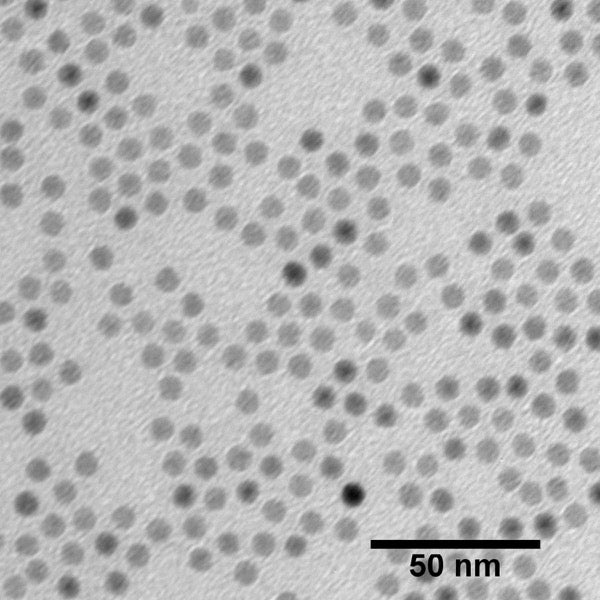
Highly monodisperse magnetic nanocrystals can be produced through thermal decomposition of organometallic precursors in organic solvents. This approach supports precise control over nanocrystal size and produces particles compatible with nonpolar organic environments.
Oleic-acid-coated iron oxide particles have been produced from approximately 4–20 nm in diameter by adjusting reaction conditions. Surface modification or growth of a silica shell can subsequently be used to transfer these materials into aqueous-compatible environments or introduce additional functionality.

Iron-Platinum Nanoparticles
Magnetic alloy nanoparticles provide another route to tune magnetic, catalytic, and materials properties through composition as well as particle size. nanoComposix has fabricated iron-platinum (FePt) nanoparticles with adjustable iron-to-platinum ratios and particle dimensions.
The example below shows monodisperse FePt nanoparticles with diameters of approximately 3 nm.

Need a magnetic particle engineered for your application?
Talk with our technical team about particle composition, size, magnetic response, surface chemistry, conjugation, composite architectures, formulation, and custom development.
Related magnetic nanoparticle resources